

Everyone remembers where they were when they heard about 9/11. The terrible images of the twin towers on 11th September 2001 remain indelibly seared on our minds. For me, that period will always be linked with the birth of not only my son but of a music project, which, as that day played out, we weren’t certain would go ahead.
* * *
‘There they are!’ I point excitedly up the road to the right, where a small group of wooden lodges nestle against a backdrop of trees, their distinctive, large A-shaped roofs sweeping low. My eyes widen, imagining woodstove-cosy interiors, and the easy comfort of substantial sofas, thick rugs, and the fresh scent of pine complementing Scandinavian minimalism. In my mind’s eye, I am there, relaxing on the balcony, letting my gaze drift over the stillness of the evening, as a low sun dips behind the hill to the sound of fiddles tuning up ready for a session.
Bruce pulls the car into a lay-by a little way up the road and turns off the engine. We sit quietly, studying, assessing the potential. When we first began discussing the idea of starting a music school it seemed like a fairly natural development. We had both attended other courses and workshops, as tutors and participants, and four years previously we had returned from Alasdair Fraser’s Valley of the Moon Scottish Fiddle School in the United States, bursting with enthusiasm and the overwhelming conclusion that there was nothing quite like it in Scotland. Against this backdrop of experience, we are convinced that a week-long, residential school, to be taught by the band members of Blazin’ Fiddles, would work. The question is, where?
Hence our reconnaissance drive around our shortlisted locations, weighing them up and trying to imagine nearly one hundred fiddlers descending from around the world, all needing fed, watered and a bed for the week. The right place must be within easy reach of Inverness’s transport links, have sufficient accommodation for tutors and participants, provide adequate facilities and teaching space, and be big enough to meet our needs but small enough to feel intimate. Oh, and must be extremely picturesque and appealing to fiddlers from afar who may never have visited Scotland before.
Our previous port of call – Drumnadrochit on the shores of Loch Ness – certainly ticked a lot of those boxes but we wondered now if this cluster of lodges might allow a more self-contained feel for our musical enterprise.
‘Everyone would be together…in among the trees,’ I enthuse. ‘Just like Valley of the Moon!’
As soon as the words are out, I realise how silly this sounds.
‘Okay, these ones might not be three hundred feet high but apart from that…’
It dawns on me that I’m gushing, imagining camp-fire ceilidhs under the stars, just as we had enjoyed at Valley of the Moon, everyone bunked up on the hillside as threads of fiddle tunes weave out over the loch. Bruce says nothing.
‘What do you think?’ I ask, guessing that he is not sharing my enthusiasm for this wholesome girl-guide vision. He cuts to the chase.
‘There’s no pub.’
He’s right. The watering hole, essential for lubricating the wheels and indeed the engine of our proposed musical machine, is missing.
‘Could we taxi folk to the nearest hotel?’ I venture.
‘Too many, too expensive,’ reflects Bruce.
‘What about buying in a load of drink and just having an honesty bar…like Valley of the Moon?’
My husband snorts. ‘Are you serious? That was California, where no-one drank anything. Except us Scots!’
He starts the car and we move off. I feel the Nordic dream slip from my grasp as we leave the lodges behind and labour up over the hill. Occasional whitewashed cottages brighten miles of winding road and field before we spy a glint of firth in the distance. Descending to the main road, we join a sudden busy sweep of traffic into the village and, passing the majestic Phipps Hall on the left and a string of Bed & Breakfast houses on the right, we swing into the parking area of the main square.
Not so much a square as an oblong, it is bordered on both sides by strings of shops, with the ubiquitous village war memorial dominating its centre. As we saunter down one side and up the other, we are surprised at the variety of businesses; butcher, baker, ironmonger, chemist, antiques and gift shops, cafes, designer boutiques, a country clothing store with large windows resplendent in tweeds and tartan, a bank, post office, and even a beauty salon.
There is a homely bustle of folk going about their errands and the place exudes warm charm and character. Traditional in the sense of a Highland village still embracing its array of family-run shops – the nearest thing to a chain is the Co-operative grocery store – but with the unmistakable feel of a thriving hub. We’ve been here before many times of course but not studied its wares quite so closely. As well as the wonderful tardis of a hostelry/hotel, the Caley, it boasts two other fine hotels, which, along with all the B&Bs and guest houses, comprise more than enough accommodation for all the tutors and students we hope to attract. The magnificent Phipps Hall, in dark red sandstone, is imposing and large, more than capable of hosting concerts for two hundred music fans.
We stroll among the ancient ruins of the Priory, astonished at the scale and detailed intricacy of this still-towering edifice. Here we are, one year into the twenty-first century, but this community was clearly a thriving centre of some importance as far back as the thirteenth, the information board advising us that Mary Queen of Scots herself overnighted within these secure walls.
Wandering down the little path from the monastery into the old primary school, now an information and resource centre, we find, to our delight, the original classrooms, toilets and kitchen, all in great condition and complemented by a sizeable car park. Currently housing an exhibition, this pleasing old building, for so long the home of education in the village, could once more be a place of study and learning, perfect for our fiddle classes.
Later in the Lovat Arms Hotel, we slide into a booth, either side of the table with our coffees.
‘This place is amazing,’ I laugh. ‘It’s got absolutely everything we need.’
The icing on the cake that clinches it for us is the area’s musical heritage. Fiddle teacher, Donald Riddle, who taught Bruce and fellow Blazers Duncan Chisholm and Iain MacFarlane, had lived on a croft in the hills above Beauly, to where, as young lads, they travelled for their weekly lessons. Morison’s, the village ironmonger’s shop, had, over a century before, provided a home-from-home for fiddle legend Scott Skinner when times had been hard for the Strathspey King, even playing in the Phipps Hall shortly after it opened. This location is brim-full of character and musical history.
We reach across between the cups to hold hands, smiling with the warm pleasure of knowing our vision is one step closer to realisation.
‘The recce’s over,’ we agree. ‘This is definitely it!’
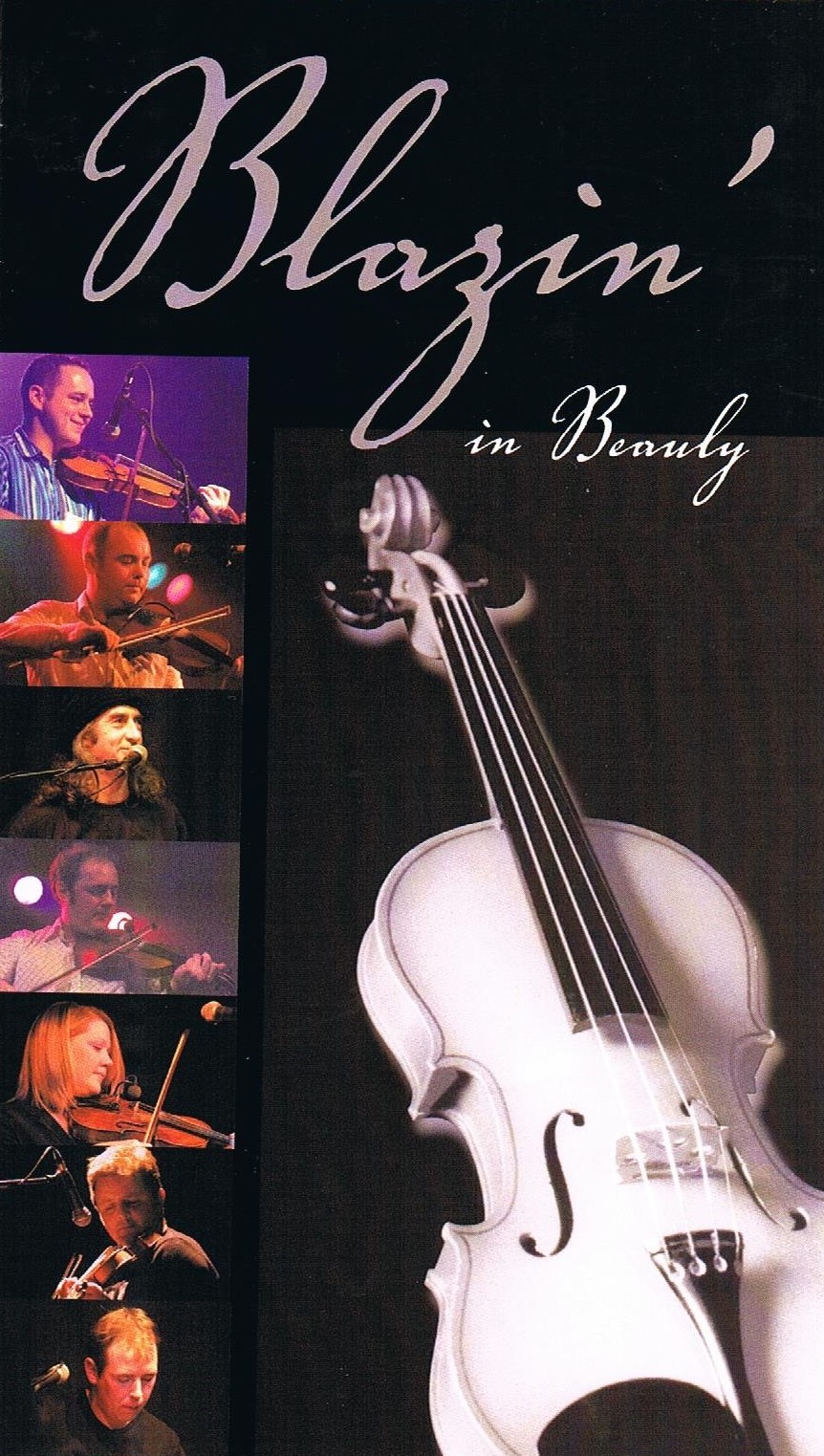
It, by neat coincidence, even begins with a B. Blazin’ in Beauly is born.
* * *
So that was how it started 25 years ago. Bruce would later observe that, ‘A true partnership starts with the sharing of dreams and our desire to create projects like Beauly began with proactive work and discussion.’ He was so right. A vision of something; not some pie-in-the-sky notion, but an idea based on our own experience. Like any venture, it was to some extent a leap of faith but, equipped with broad knowledge of other music schools, it was not a leap in the dark.
We had both taught at numerous fèisean, attended short courses together at Sabhal Mòr Ostaig, knew what had worked for us as students at Valley of the Moon, and were regulars at Fèis Rois’s Adult Fèis – indeed it was where we had met six years previously – so had a good feel for what students might be looking for, what tutors’ needs were, and what would be required for the successful flow of a week-long fiddle school.
Throughout those summer weeks we got to work in earnest, compiling what felt like endless lists; schedules, provisional programmes and timetables, classes, tutors, volunteer helpers, funding applications, accommodation and travel outlines, items to be bought, timeline of to-dos up until our BinB start date in October, people to be contacted, local Beauly folk to be consulted, and slowly there began to take shape the bones of something tangible. It was 2001, before the internet and Facebook – even email was new – all those things that would go on to make event promotion so easy. Looking back from today’s standpoint of 2026, when we can create a social media event or AI poster in seconds, it certainly seems like the dim and distant historic past! Thankfully we had the superb graphic talents of Ronan Martin, who created all our leaflets and posters with his striking and attractive designs.
I was seven months pregnant and all going well with my pregnancy, but all at once an event hit the world that would stop us in our tracks and wonder if our fiddle school was even do-able. It was the 11th of September, and I had gone to the gym in the morning, not to work out but for the swim that would relieve me of the weight of my fast-growing baby. Getting changed afterwards, I watched a bizarre scene play out on the TV screen; two planes were flying into the Twin Towers of New York. At first, I thought it was a film but quickly realised it was a news programme; I stared in horror before heading home in disbelief.
The events of that day left everyone reeling in shock and sadness. As we watched the evening news at home we couldn’t quite take it in; the magnitude of it, the immense loss of life, and simply the inhumanity of those who would plan and carry out such acts. However, we had to get out to Beauly. We had organised a public meeting for local folk to come and meet us, to hear about our plans and ask questions about how it might benefit or impact the village, but as Bruce and I sat alone in the Lovat Arms room, chairs spread out for the meeting and minutes ticking by, we quickly realised no-one was coming.
It didn’t auger well for us. Did this mean that locals were not interested, didn’t want to be involved, or was it just the events of the day that overtook the minds and thoughts of everyone? It was of course the latter. The village, it turned out, was right behind us, unwaveringly supportive, taking posters for their shops, bringing us armfuls of amazing raffle prizes and looking forward with huge enthusiasm to the week-long fiddle extravaganza.
When the day arrived and the rest of Blazin’ Fiddles rolled up, to be met by over 80 fiddlers and everything in place down to the last teabag, they were stunned; musicians had travelled from as far away as the USA and Canada, and from all across Britain, Ireland and Europe. The week was a great success and was perhaps something of a balm for participants in those difficult days, proving that in midst of dark times music and camaraderie can help heal.
The rest, as they say, is history. Over the years we developed the offering further with classes in everything from groupwork to fiddle care, along with guest tutors from around the world. Complemented by ceilidhs, concerts, sessions, quiz nights, banquets, history bus tours, whisky tastings, hilarious lampooning sketch shows, the Beauly week become more than just a music school – more of a total immersion in Highland culture and always underpinned by the wonderful support within the village. We were thrilled to win Best Community Project at the Trad Awards in 2003.
Of course, there have been major changes since then. Blazin’ Fiddles now consists of completely different musicians, although I do recall at least one of the current line-up attending Blazin’ in Beauly as a child. I am also no longer involved but as people all over the world reflect on the 25th anniversary of 9/11, it is heartening to recall that many strands of positivity did indeed blossom in its immediate aftermath, not least in our traditional music world.