


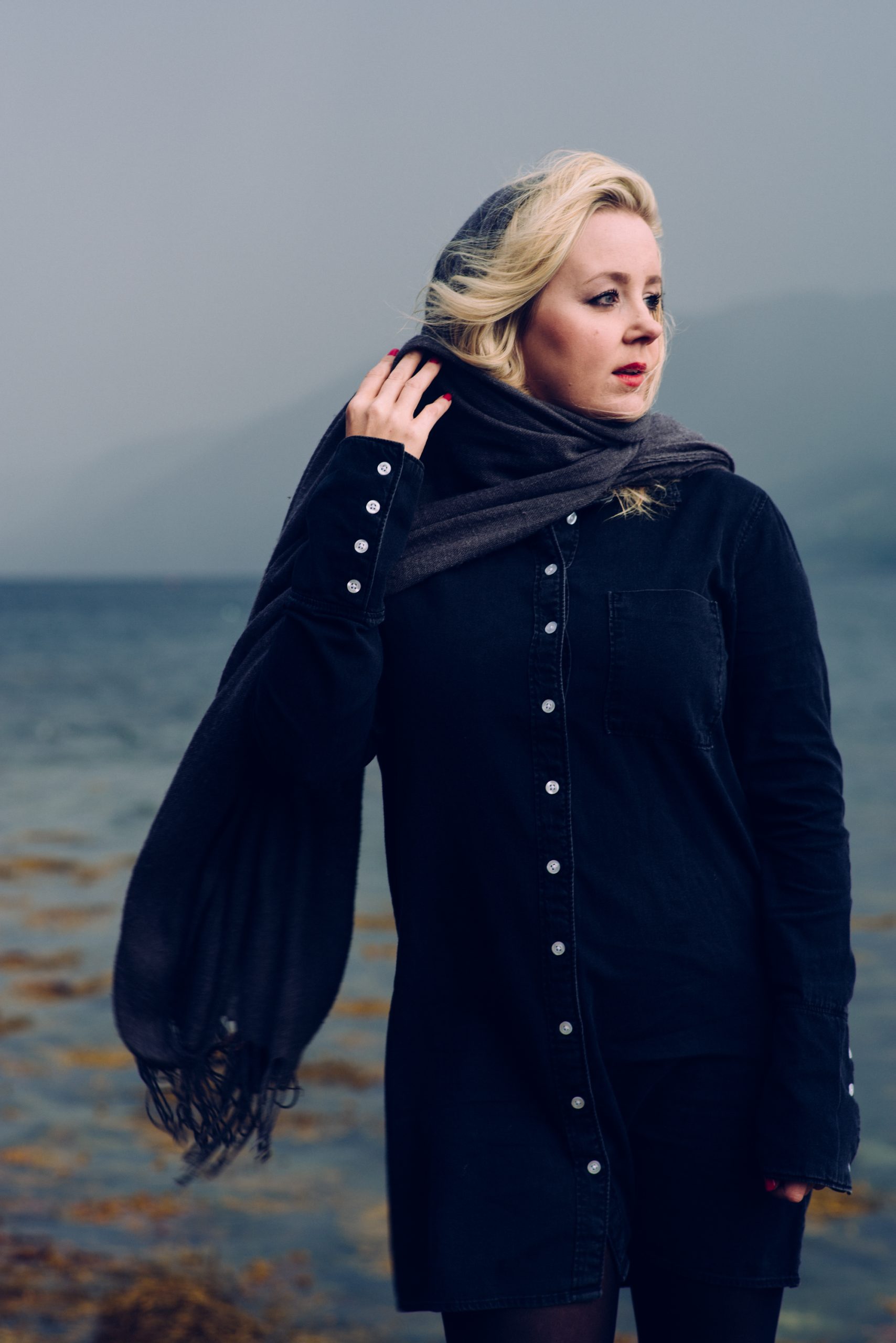
📷 Photo by Somhairle MacDonald
Hi, I’m Kim Richards, and I live and work in the beautiful West Coast village of Ullapool. When people ask what I do, it takes me a moment to decide what to say and what role to prioritise as this changes regularly.
In no particular order, I’m a secondary school art teacher, music tutor, singer, artist, musician, designer, mum, and student. Life is busy, but life is certainly never boring. Creativity is at the heart of most of the things I love to do, and I thrive on learning, reflecting and adapting. I’m utterly inspired by my surroundings, especially up here in the Highlands of Scotland. The environments around me have been the basis of most of my creative work to date, in my artwork and in my music.
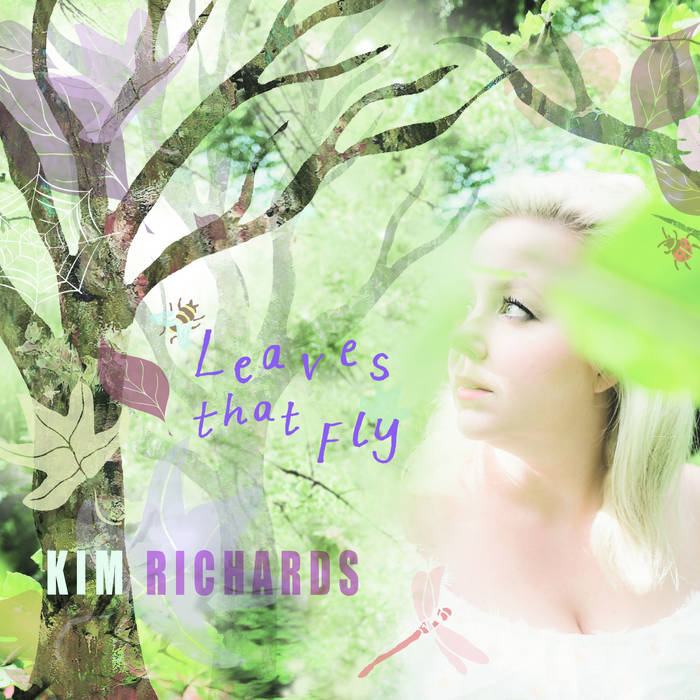
Leaves that Fly – album by Kim Richards
A bit like everyone else, my life took a big turn in 2020. After 2 weeks of becoming a new mum, we were in lockdown. My environment became ever more important during this time, and it sparked a flurry of creativity. It also offered a rare chance to slow down a bit, and to build on ideas with time and with space in between.
I’ve always split my time between art and music and tried to find the right balance, all the way back to my time studying at The Glasgow School of Art. The thinking space during lockdown led me to the realisation that they don’t have to be separate for me, and I wanted to find a way to merge them together.
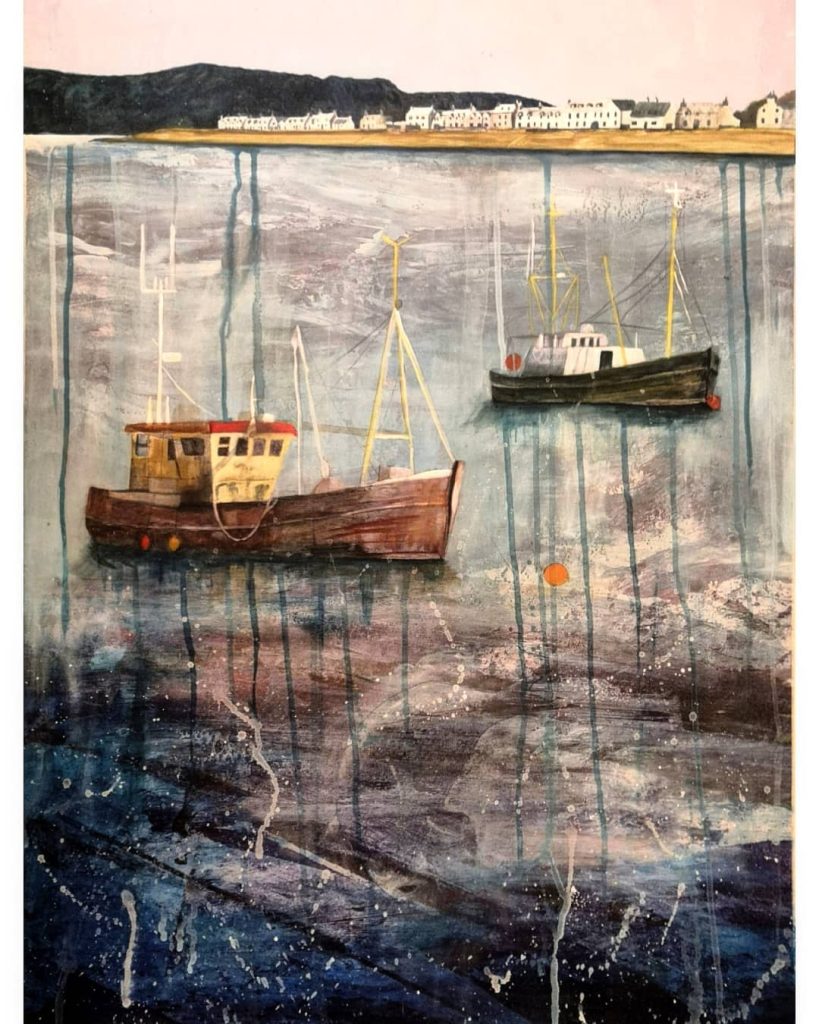
The Point and Fishing Boats (mixed media on canvas) – by Kim Richards
It was around this time that I realised if I wanted to pursue new creative projects and outlets, I needed to find a structure and set aside time for this, or life would fling me in different directions at full speed. I started thinking about the prospect of studying again as I liked the idea of having set timeframes and deadlines to work towards. Over the years, I had heard echoes of folk mentioning completing some or all of the modules on a course with a title that resonated with me – Music and the Environment. As I researched further, it was clear that the MA Music and the Environment course encapsulated so much of what I believe to be important for my own inspiration, and for my own creativity. Now, some might think it mad to begin a Masters Degree with pre-school children, but to me, it made perfect sense, and thankfully my patient husband supported me in this endeavour!
Being able to do the masters course part time has been a huge benefit for me, and having the adaptability of choosing how many modules per semester I can undertake. Due to having a busy workload outwith the course, I have not been able to attend all the scheduled tutorials, but these are recorded which has meant that it has been possible to keep up with important discussions and coursework. I am now two years in and have just completed a module working on a collaborative project led by MA Music and the Environment Programme Leader Simon Bradley.
October feels like a long time ago now that I apprehensively clicked the button to join the Teams meeting to meet my fellow musical collaborators for the first time. The use of technology was a bonus for our group considering Gail lives across the water in Boston, Massachusetts, and Rob, resides near Newcastle. Thus, technology made otherwise impossible collaboration possible. Waldron (2013) argues that online collaboration promotes heightened metacognitive awareness because musicians must verbalise and justify their creative decisions more explicitly, and I believe the online setting strengthened my communication and collaboration skills as I had to articulate my musical ideas more clearly. It was clear from early on that we were a diverse group in terms of our musical styles with Gail coming from a jazz background and Rob with his cross-over in jazz, folk and indie styles.
Our group was given a brief to produce a piece of music for The Scottish Wildlife Trust as part of their Sea the Connection initiative. Launched in 2024, Sea the Connection is a three year marine engagement project that aims to increase ocean literacy across Scotland. Some of its main aims are empowering communities to participate in marine decision making and policy conversations and raising awareness and connections to people’s relationship to the sea. As a group we discovered that composing a piece that highlighted both a maritime issue, a sense of connection and the beauty of the sea was at the forefront of our ideas.
A landmark moment in our collaboration came when we were asked to present our initial ideas to Elouise Dalziel, the Marine Policy Inclusion Officer of the Scottish Wildlife Trust. This gave us our first official deadline and spurred us on to start our creation of the music. The meeting with Elouise was very insightful and we gained more information to help us build on the theme of our composition. Some key takeaways from this meeting were that the initiative is keen to make marine policy accessible to all and to spark conversations. They particularly want to connect with Gaelic voices and get people connected with the sea in fun, engaging, joyful and meaningful ways. So we were keen to add elements of hope, and a sense of community and place to our piece.
I composed a Dm chord sequence in jig time as we thought this traditional Scottish edge might be more accessible to listeners in Scotland. Rob contacted David De La Haye to seek permission to use his underwater recordings of seals and other marine life as part of our project. This tied in well with the theme of the sea. Rob mixed the recordings together and this was the first time we heard the merging of our sounds. In order to reach Gaelic speakers and link the composition to Scottish culture, I thought adding a Gaelic refrain over the jig chords might work. I imagined giving a voice to all humans and creatures that use the sea. The lyrics that I kept coming back to were “Save our Sea” or “Save our Ocean”. In English, these lyrics could be portrayed as preachy and potentially cheesy, but in the Gaelic language the words “Saor an Cuan” (Save our Ocean) sound beautiful and add interest to the piece. I created a melody for the lyrics and added a harmony to create a sense of more than one voice.
When it came to the overall instrumentation and ‘sound’ of the piece, there were questions about how far we should move away from the traditional Scottish sound we should allow ourselves to go, especially from Gail and her husband, Lorenzo, who offered to add bass and vocals to the piece, with their operatic and jazz backgrounds. As our musical piece was about connections, journeys and a sense of togetherness, we were very keen for each style to come through. It also could contribute to the accessibility of the overall piece, thus reaching more people. We agreed that we would create a set of tunes starting with a jig into a reel. Gail created a chord sequence for the first part of the reel and these chords inspired my writing of the notes for the reel and a second part with chords. It wasn’t long before Gail recorded the tunes on the saxophone and Lorenzo added bass lines. It was the first time I had heard any tunes of mine played on a brass instrument. I found this part of the project really exciting as it started to feel like our group was starting to ‘play music together’. I gathered words and phrases that I thought linked with our theme and selected the most relevant to create a call and response element. I thought this would further emphasise the feel of connection to the sea as it likened that of a sea shanty. It also worked well within the themes of our group as it brought in more voices, almost creating the idea of people giving a voice on marine policy.
Rob nominated himself to do the mixing of our piece as he had the most experience of this being a mixing engineer and musician. He added wonderful rhythmic touches with his guitar, and mixed these with his own percussion playing and some provided by Gail.
Flexibility was a key element of our collaboration when juggling different time zones, work commitments and ideas. I learned that musical ideas improve by drafting, revisiting, and reshaping themes. This aligns with Schön’s (1983) concept of reflection-in-action that emphasises learning through ongoing experimentation and thoughtful adjustment. The process taught me that embracing uncertainty can lead to richer musical outcomes.
The lessons learned from this online musical collaboration, ranging from improved communication and technical preparation to adaptability, time management, and emotional awareness, will directly inform my future practice. These insights have deepened my understanding of what it means to collaborate musically in a digital space, equipping me with the skills and mindset needed for more effective and rewarding creative work.
The composition is called A Continuum Between Shores which I think encompasses the project and what we were trying to achieve to fulfil the brief. When I think back to October and my initial worries about working in a group entirely online, I feel much more positive about this way of working, as it seems that it does in fact work well. Working alongside musicians from different backgrounds and styles of music has enlightened me to new ways of thinking and made me feel more comfortable about working outside my comfort zone. I think our final piece has lots of interest and works as almost a triptych in structure. We have a variety of instruments running through it with flute, whistles, bass guitar, acoustic guitar, piano, and saxophone, to name a few! I have thoroughly enjoyed the experience of working alongside Simon and Elouise, and in musical collaboration with Rob and Gail. I am excited to work further with Rob and Gail on the piece in order to bring it on further to reach its full potential. Our collaboration and blending of creative perspectives have brought different influences, leading to new sounds that I could not have created alone.
I am fortunate to have the ability to undertake this course, and I am excited to begin the final stage – a personal project where I will develop my own musical and artistic composition in the form of an album and corresponding artwork, hopefully! I know that weighing up the decision to take the leap into further education can be challenging, but my experience has been extremely rewarding and satisfying, and I feel so much more equipped and inspired to pursue my creative endeavours.
https://kimrichardsmusic.bandcamp.com/album/leaves-that-fly
MA Music and the Environment course
Enroll for January or September start, full time or part time.
References
Schön, D.A. (1983) The Reflective Practitioner: How Professionals Think in Action
[Online]. Available from:
https://raggeduniversity.co.uk/wp-content/uploads/2025/03/1_x_Donald-A.-Schon-The-Reflective-Practitioner_-How-Professionals-Think-In-Action-Basic-Books-1984_redactedaa_compressed3.pdf
Scottish Wildlife Trust (n.d.). Sea the Connection [Website]. Available at:
https://scottishwildlifetrust.org.uk/our-work/our-projects/living-seas/sea-the-connection/
Waldron, J. (2013). ‘User-Generated Content, YouTube and Participatory Culture on the
Web: Music Learning and Teaching in Two Contrasting Online Communities’ [Online].
Available from:
https://www.tandfonline.com/doi/full/10.1080/14613808.2013.772131?needAccess=true#d1e323